Guys, how easy is it to get the manifold off and reinstalled? Does it involve a lot of work? I should be able to get a machine shop here to do the work for me. They are the same guys who run the turbocharged Lambo engines for the Class 1 Powerboats here in Dubai
http://www.victoryteam.ae/
now i love it...


Pippyrips - Yes, I simply ordered a new manifold. I am curious too just what the transition looks like at the machined "trumpet" inlet as well as the portion leading directly to the cylinder head.
ghoonk - The manifold is cast aluminum. It looks to be a fairly straightforward job. Will probably have to disconnect the fuel rails to be able to lift the manifold straight up. I am more concerned with the actuators controlling the manifold flaps (you can see them on the very front of the manifold) and getting the flaps properly installed into the new manifold. There is a well respected VW/Audi repair shop near me that should handle it just fine.
ghoonk - The manifold is cast aluminum. It looks to be a fairly straightforward job. Will probably have to disconnect the fuel rails to be able to lift the manifold straight up. I am more concerned with the actuators controlling the manifold flaps (you can see them on the very front of the manifold) and getting the flaps properly installed into the new manifold. There is a well respected VW/Audi repair shop near me that should handle it just fine.

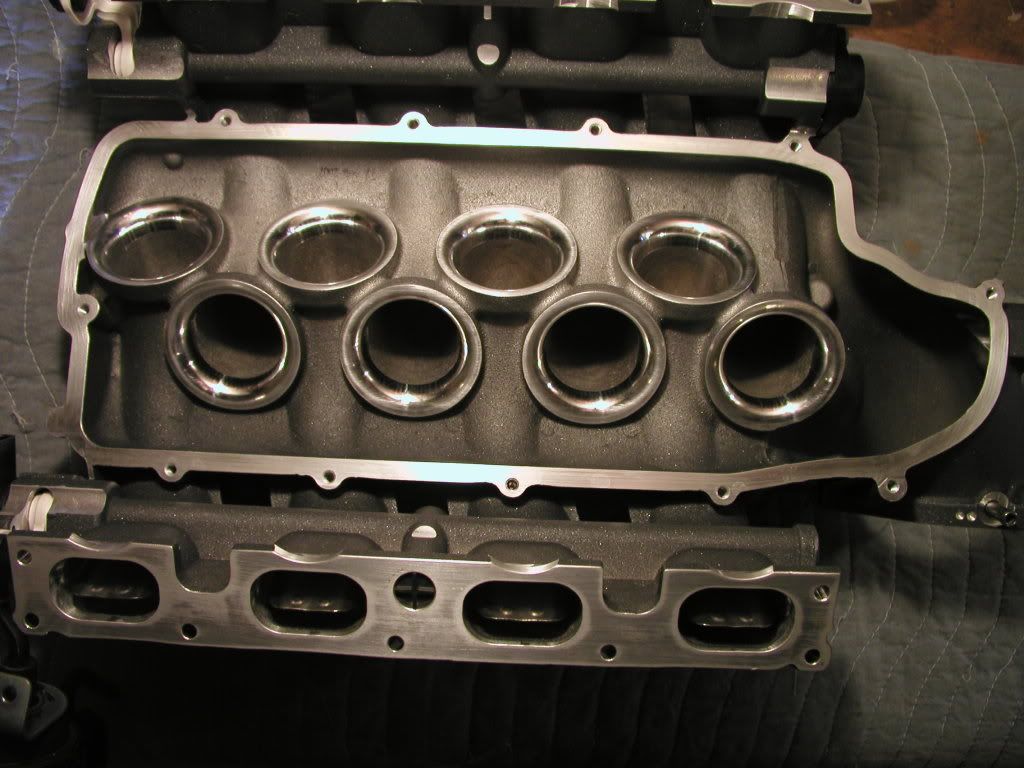
Sorry for the delay. This post should be read VERY CAREFULLY to avoid confusion. When I got involved with this thread, my RS4 was in the shop because it was not running properly. The "Before" info in these graphs is before it was repaired. The "After" is how the car it is now, now that its fixed. The before and after do not have anything to do directly with my manifold. So what was wrong with my car? Well first of all it never felt like it had 420 HP. I ran the 1/4 mile several times and could never get the trap speed over 106mph. I also had 2 CEL's due to cold start "misfires". When I took the car in for the third "misfire" CEL, the dealer decided to look closely at the fuel system. Sure enough, three of the injectors were bleeding off fuel into the cylinders when the engine was off (i.e. not holding the residual pressure in the fuel system). So when the engine was cranked over, there was too much fuel in those cylinders, causing the misfire. It wasn't due to the coils, it was faulty injectors. They proceed to remove the manifold to replace all the injectors and they discover a fair amount of carbon build-up on all the intake valves. I saw it with my own eyes and it was pretty bad. All I've ever used is a Shell Tier 1 fuel, so they didn't really have an explanation. This carbon build-up seems to be a problem with the American market direct-injection motors. So they cleaned up the valves and put everything back together. Once I got the car back on the road, it was instantly noticable that the car was running much, much better. I've logged mass air flow many times with VAG-COM, and it was never over 140 g/s. That's now been improved by over 10%. The power is stunning as well and I think its finally running like it supposed to. The "after" acceleration graph shows this. So what's this got to do with the manifold work? Well, I purchased a brand new one and took a hard look at it (picture is of a untouched, out of the box Audi manifold with the lower cover off so you can see the nice, polished inlet trumpets). I thought the "lip" was practically nonexistant. Sure they could be smoothed, but in my opinion, its not worth messing with. So that realization, along with the discussion I had with the lad who took my manifold off to get to the fuel injectors (definitely not for the layman with no special tools!) has me thinking I'm going to leave mine alone.


Glad you've sorted the car SilverRS4,
Those new times are what my car runs and I'd say they're pretty much spot on. I think the car does 98 in 9.9 and then you have to shift into 4th...
So what are we saying now?
AntoRS4's performance is due to...?
Those new times are what my car runs and I'd say they're pretty much spot on. I think the car does 98 in 9.9 and then you have to shift into 4th...
So what are we saying now?
AntoRS4's performance is due to...?
58 C6 RS6 Stage 2+
58 C6 A6 Allroad 2.7 TDi
Previous:
2000 B5 S4 MRC 550 Saloon
2007 B7 RS4 Saloon
1994 S2 Coupe
58 C6 A6 Allroad 2.7 TDi
Previous:
2000 B5 S4 MRC 550 Saloon
2007 B7 RS4 Saloon
1994 S2 Coupe

SilverRS4
your airflow (after) graph is exacly the same as mine with stock manifold
now i can see 169/170 gr/sec @7800 to 8000 rpm
0-100km/h 4.2 sec
0-160km/h 9.4 sec
0-200km/h 15.4sec
0-1000m 22.7 sec
I'm not here to sell anything...
about carbon deposits on valves: what engine oil are you using ? do you use the car only for short trips ?
remeber that rs4 should be drove only at wot over 6000rpm
your airflow (after) graph is exacly the same as mine with stock manifold
now i can see 169/170 gr/sec @7800 to 8000 rpm
0-100km/h 4.2 sec
0-160km/h 9.4 sec
0-200km/h 15.4sec
0-1000m 22.7 sec
I'm not here to sell anything...
about carbon deposits on valves: what engine oil are you using ? do you use the car only for short trips ?
remeber that rs4 should be drove only at wot over 6000rpm
-
BlingBling

- 4th Gear
- Posts: 669
- Joined: Tue Jul 25, 2006 7:59 am
- Location: Bremen, Germany
octane rating doesnt affect airflow, only ignition time advance...BlingBling wrote:If SilverRS4 is from the USA then his times will differ from EU due to the octane rating of American fuel. I believe that the US does not have 97, 98 or 100 fule so his performance/time willl be default be slower. I stand to be corrected though.
-
BlingBling
- 4th Gear
- Posts: 669
- Joined: Tue Jul 25, 2006 7:59 am
- Location: Bremen, Germany
My air-flow is at 158-161 g/s at 7700-7900 RPM. So your flow is roughly 5% better. That is significant and would make for a noticable power improvement. We can see from above what a 10-12% improvement does. Now you got me thinking again. I had the manifold already boxed up and ready to send back...AntoRS4 wrote:SilverRS4
your airflow (after) graph is exacly the same as mine with stock manifold
now i can see 169/170 gr/sec @7800 to 8000 rpm

As for oil, I use Mobil 1. You are correct that the oil, rather than the fuel, is probably the culprit.
Anto,
Concerning the carbon build-up - I followed the Audi recommended break-in. At 3500 miles, I changed the oil from the factory fill to Mobil 1 (0w-30 or 40, I can't remember which, but it is VW502 approved) and have used it since, with one additional oil/filter change. I now have 8600 miles. The car never ran well, until the repair described above. Of course when the engine had the factory oil in it, I never really pushed the engine, so I can't really say if it was running poorly then.
The only way to see what's going on would be to change oil to a different brand or viscosity (like what?) and pull the intake off after a few thousand miles and take a look at the valves. What fun! Also, if the European engines are truly seeing no such build-up, it then looks like a fuel issue, not oil. Its very hard to say whats causing it.
P.S., Did you know the VAG-COM reported air flow is gram/sec is actually only 1/2 of the air-flow into the engine? I think its because each of the twin ECM's control 1 bank of 4 cylinders, rather than the master ECM controlling all 8. Since each ECM is responsible for half of the fuel delivery, they only see (and report)half of the air flow. Another way to check is a Volumetric Efficiency (VE)calculation. A motor that produces 100HP/liter should easily have a VE over 100%. But for example, with a dry air density of 1.1 kg/m^3 and a flow rate of 160 g/s at 7800 rpm, the resulting VE is only 54%. In actuality, with the RS4 engine, the flow is 320 g/s and the VE is 108%. For the math folks out there, keep in mind that with a four cycle engine, it takes 2 rev's for all 8 of the cylinders to go thru a intake stroke.
Concerning the carbon build-up - I followed the Audi recommended break-in. At 3500 miles, I changed the oil from the factory fill to Mobil 1 (0w-30 or 40, I can't remember which, but it is VW502 approved) and have used it since, with one additional oil/filter change. I now have 8600 miles. The car never ran well, until the repair described above. Of course when the engine had the factory oil in it, I never really pushed the engine, so I can't really say if it was running poorly then.
The only way to see what's going on would be to change oil to a different brand or viscosity (like what?) and pull the intake off after a few thousand miles and take a look at the valves. What fun! Also, if the European engines are truly seeing no such build-up, it then looks like a fuel issue, not oil. Its very hard to say whats causing it.
P.S., Did you know the VAG-COM reported air flow is gram/sec is actually only 1/2 of the air-flow into the engine? I think its because each of the twin ECM's control 1 bank of 4 cylinders, rather than the master ECM controlling all 8. Since each ECM is responsible for half of the fuel delivery, they only see (and report)half of the air flow. Another way to check is a Volumetric Efficiency (VE)calculation. A motor that produces 100HP/liter should easily have a VE over 100%. But for example, with a dry air density of 1.1 kg/m^3 and a flow rate of 160 g/s at 7800 rpm, the resulting VE is only 54%. In actuality, with the RS4 engine, the flow is 320 g/s and the VE is 108%. For the math folks out there, keep in mind that with a four cycle engine, it takes 2 rev's for all 8 of the cylinders to go thru a intake stroke.
Who is online
Users browsing this forum: No registered users and 152 guests